
Cable TV Customer? “Channel Bloat” May Be Costing You Over $1,600 a Year


When picking out a new TV package, most folks go in thinking, the more channels, the merrier! I mean, cable companies historically love flexing how many hundreds of channels they offer, with some providers like Verizon Fios offering upwards of 400 channels on their top-tier plans.
But is that the truth? Are more channels really worth it, especially when cable TV plans are so darn expensive?
Drawing on data from vetted external studies and a survey CableTV.com conducted with nearly 27,000 real TV customers, we’ve discovered how much Americans are wasting on their cable plans each year, and what to do about it if overpaying for TV is an issue your family is facing.
Are you wasting $1,600 a year on unwatched channels?
As I said, cable companies for a long time loved to tout their huge channel counts. But recent studies have proved that bigger doesn’t always mean better.
In a study done by CordCutting.com, experts found that while traditional cable packages average about 195 channels, most people watch only about 15. If you figure an average cable TV bill of $147, that’s roughly $9 per channel you actually use.
This means the average consumer is wasting $135 every month, or $1,618 a year, on unwatched channels.
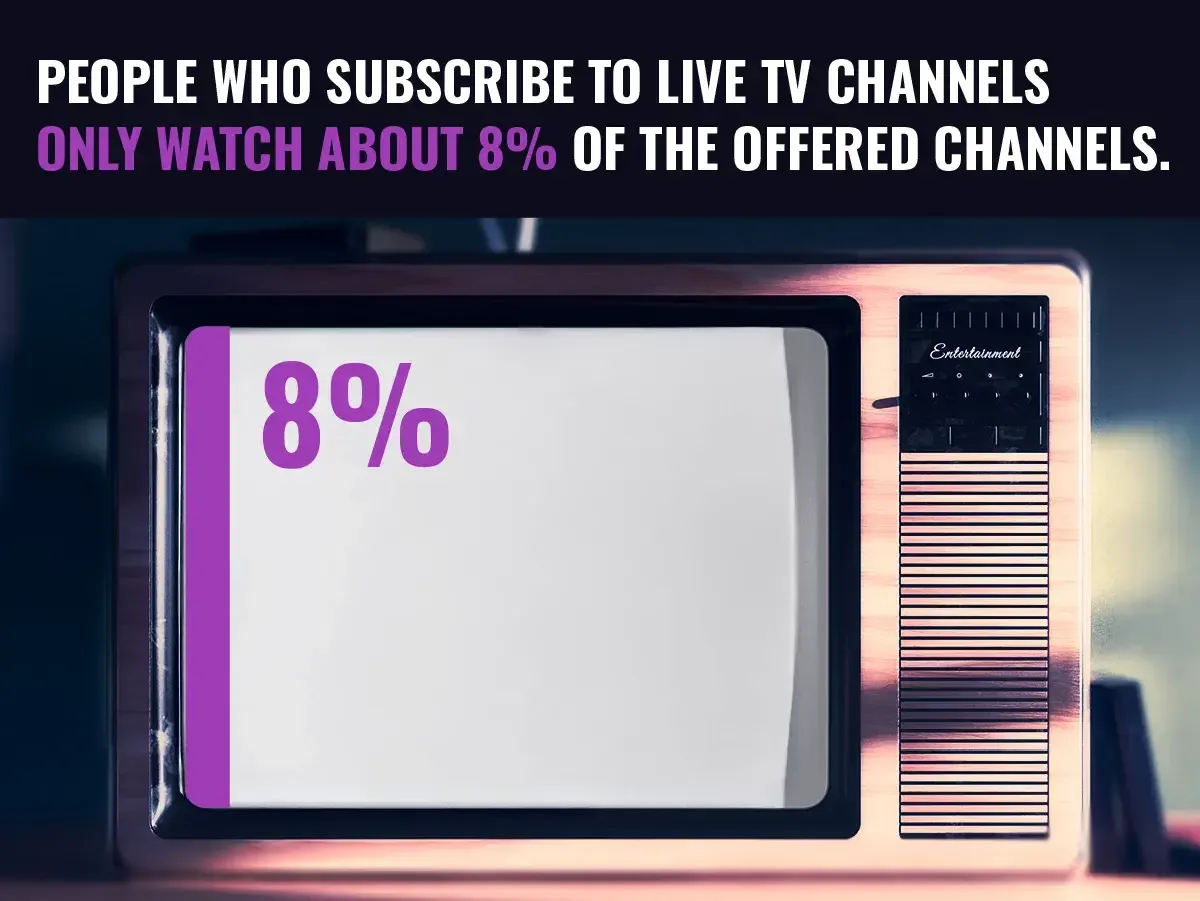
The “true cost” of each watched channel comes out to $9.57, which is more than the price of many standalone streaming services.
With the cost of that one single channel, you could pay for an ad-supported Netflix subscription and watch oodles of content—18,000 titles worth, at the touch of a button—and still have a buck fifty left to spare.
How much are people paying for TV in 2025?
We still wanted more information on exactly how much folks are spending on their cable and streaming bills in 2025 to understand how cutting “channel bloat” could impact the average American’s monthly budget.
So, we conducted a survey in which we asked 26,500 people how much they spend per month on internet, TV, and streaming services.
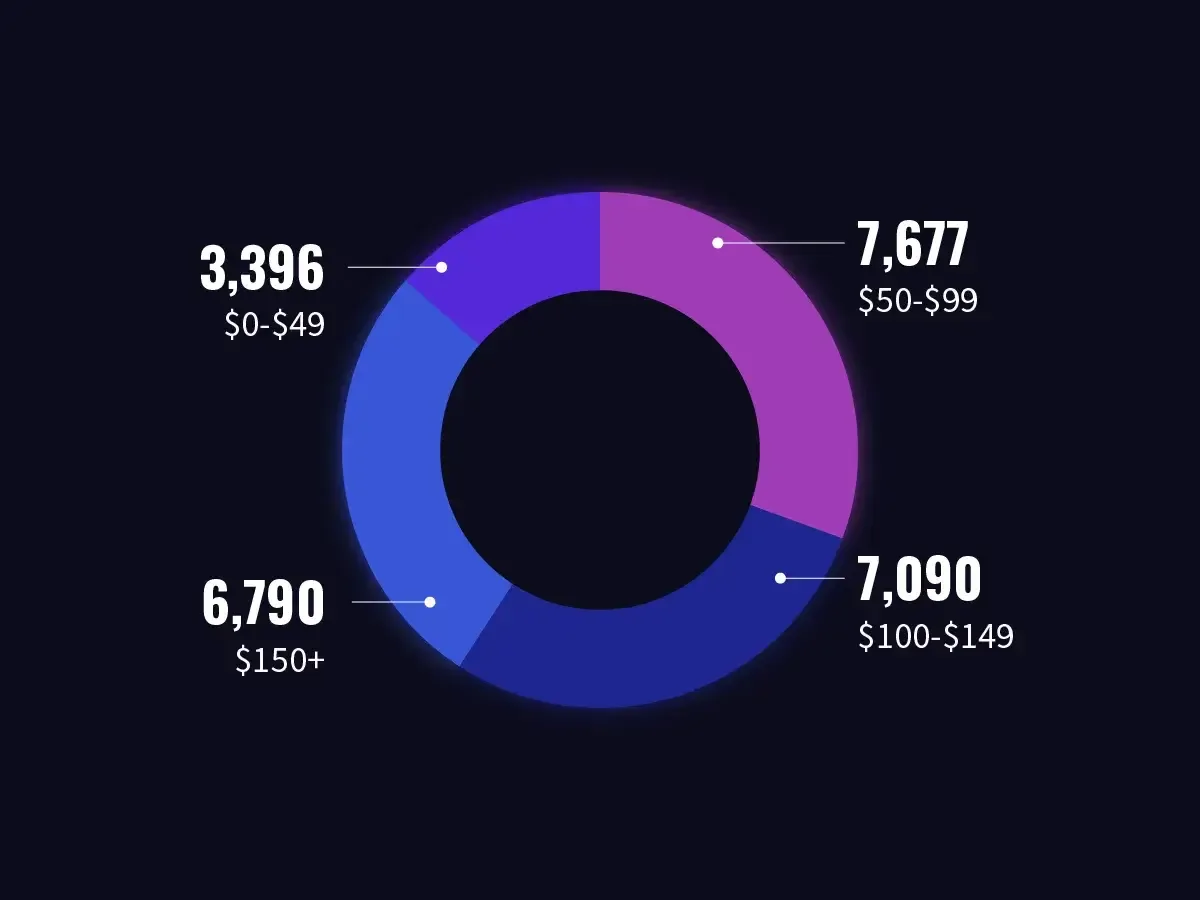
Unsurprisingly, the majority of respondents fell within either the $50–$99 or $100–$149 per month ranges (14,767 total respondents), with another 6.7k saying they pay a whopping $150 or more for all their services.
In a survey we ran last year, we learned that 82% of people who pay for cable TV also pay for at least one streaming service. This is corroborated by our new study, in which 21,466 of 26,500 respondents reported paying for at least one streaming service (81%), even if they already pay for cable.
This data didn’t come as a surprise to me. We all know that streaming services are increasingly popular, with cable TV no longer holding even half of the global TV market share compared to streamers. But it still astounded me that so many people pay for cable plans and streaming services when so many cable channels go unwatched. If some of these customers cut the cable cord, they could save over $1,600 a year.
According to another recent study by MNTN Research, 62% of customers think they’re wasting money on their average cable TV bill. Traditional providers have begun to recognize this frustration, and are joining a growing trend toward lower channel counts and more flexible TV options.
Cable companies are cutting channels to compete with streaming
As a tech journalist who’s covered TV and streaming price updates for the past three years, I’ve noticed a recent trend among traditional TV providers: trimming their channel counts.
I discuss this trend in last year’s TV Customer Satisfaction Survey, noting that providers like DIRECTV and Optimum made significant cuts to channel counts (sometimes by as many as 200 channels) in 2024 to reduce the bloat. They did so by removing filler and music channels that have long been used to inflate overall channel counts, even when these channels offered little-to-no watchable content.
While many cable providers are slowly reducing their bloated packages, one lean, affordable TV service has emerged as a top solution to the channel bloat problem.
Spectrum TV Stream could solve your channel bloat issues
There is one service in particular that has all the aspects of an ideal live TV solution to channel bloat, and (spoiler alert) is the top performer in this year’s TV Customer Satisfaction Survey: Spectrum TV® Stream.
Spectrum TV Stream offers a low-cost live TV alternative at a fraction of the cost of cable. For only $40 per month, customers get a curated channel count of 85+ cable and local networks that eliminates the filler channels that used to infiltrate traditional cable packages.
By offering a lower-cost, leaner package, Spectrum TV Stream lets customers keep the shows they love, while freeing up budget for additional streaming services, while still lowering their overall average cable TV bill each month.
Plus, TV Stream came in No. 1 on 12 of 20 questions in our 2026 Customer Satisfaction Survey, beating longstanding champs like Verizon Fios and Xfinity (and TV Stream’s own Spectrum cable counterpart).
For a newbie in the TV world, that showing is extremely impressive, and demonstrates that consumers are prioritizing cheaper (and leaner) TV options, as long as they provide the desired entertainment. Spectrum TV Stream ticks all those boxes—and more.
So, if you’re one of the folks who watch only 15 channels out of the 200 they pay for monthly, I recommend you take a look at Spectrum TV Stream.
Our methods
We surveyed 26,500 people and asked how much they spend a month on internet, TV, and streaming services. This survey took place in November–December 2025. We then used our proprietary data from that survey, alongside data from a CordCutters.com survey, to form the basis of this channel bloat report.
While CableTV.com may earn a commission, our survey data is independently collected.
Why you should trust us
We’re no strangers to a survey at CableTV.com. We pride ourselves on our curiosity, and we’re always curious to see what customers really think about the streaming services and TV providers we review. That’s why we run a yearly Customer Satisfaction Survey and take real testimonials into account when ranking products and services. For more on our process, head over to our How We Rank page.
