Broadcast Monopolies Just Became More Powerful, Thanks to Controversial FCC Vote

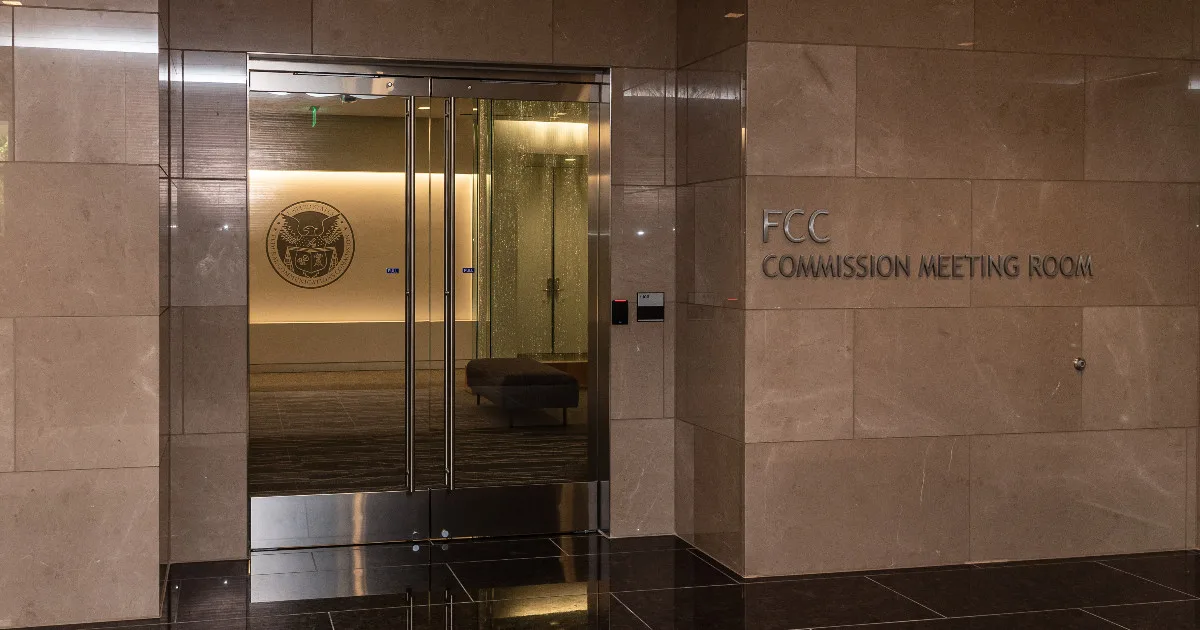
FCC removes broadcast cap: Will increasing scale do any good?
Up until now, broadcast companies were not allowed to reach any more than 39% of American viewers with their portfolios of local stations. So while your local news channel might be owned by Sinclair, another might be owned by Nexstar.
But the FCC just repealed that rule, which had been on the books for 22 years. The FCC’s chairman, Brendan Carr, has been a vocal opponent to the rule for a while. In the Breitbart op-ed he wrote last month, he rallies against “the values of New York and Hollywood executives,” a stance he’s also made quite clear in his time as chairman. Remember when Jimmy Kimmel got chased off the air? That was Brendan Carr’s work.
But with Kimmel restored to the airwaves, Carr found himself a different target: the broadcast cap. Since streaming services are allowed to reach 100% of the country, he argues, why shouldn’t local channel providers? If more local stations could join forces, (lumped under corporate umbrellas), they would have the “power to preempt or refuse to air national programming that does not fit their communities’ values.” It seems impossible to separate this viewpoint from the Kimmel scandal, where Carr tried to remove programming that went against his own values.
But I’m getting ahead of myself. I know anything to do with the FCC and airwave regulations is going to be a bit confusing, but I’ll do my best to explain.
Keep up with all the latest in entertainment news
Subscribe to CableTV.com's email newsletter for the latest TV event viewing guides, entertaining takes, and money-saving promotions.
By signing up, you agree to our Privacy Policy & Terms and Conditions.
Can they do that?
Technically, the FCC has already been allowing companies to skirt the ownership cap. Nexstar recently merged with Tegna, giving it a direct connection to 80% of the country. According to the letter of the law, that shouldn’t have happened. But the FCC gave it a pass ahead of the vote to repeal the ban.
And now that the repeal has gone through, other companies might follow suit. Or Nexstar could continue merging with more companies. Let’s go into why that may be a problem.
What’s the immediate impact?
Once again, this is a bit of a free speech issue. While a private company like Disney would be free to censor a comedian however they choose, a government-backed regulatory agency like the FCC cannot. So if Carr is trying to aid companies in silencing certain viewpoints and programs, that gets into some sketchy territory.
And then there’s the big issue, the one that made you click on this article: monopolies. Talking about giving the little guy more power is all well and good, but that’s not really what this repeal is going to end up doing. Local channels aren’t usually standalone operations. They’re usually owned by a larger corporation, like Sinclair or Nexstar.
So what this repeal will really do is give those corporations the power to buy more networks, expanding their monopoly over the airwaves. And as we’ve seen with the equally controversial Paramount/Warner Bros. merger, monopolies spell bad news for consumers. They give companies the freedom to raise prices without competition. But broadcast corporations have been envious of that merger, and until now this cap has prevented them from operating with the unregulated abandon of streaming services.
And instead of regulating those streaming services, the FCC’s solution was to level the playing field by removing the existing regulations on broadcast TV.
When it comes to American media, monopolies could have disastrous political consequences. Imagine if every news channel was forced to conform to just one viewpoint—the viewpoint of whichever media conglomerate CEO owned the most airwave real estate. It would make distinguishing fact from fiction a whole lot harder. We’re already seeing those dangers in cases like the Paramount merger, which would give CEO David Ellison the same control over news network CNN that he already has over CBS News.
The FCC cap was only just repealed, so we’ve yet to see exactly how it will change the TV landscape. But don’t be surprised if you start to see a lot more broadcast mergers popping up in the news in this second half of the year.
Watch local channels with live TV streaming
The quickest and cheapest way to catch your local broadcast stations is with an OTA (over-the-air) antenna, but if you want to stream from anywhere on any device, a live TV streaming service is your best bet. Here’s some of our favorites:

Best of the best
YouTube TV is the best live TV streaming provider on paper. For $82.99/mo., you get 100+ popular channels, including all of your local stations.

Editor’s Choice
Hulu + Live TV was our Editor’s Choice for the best live TV streaming provider in 2026. Our streaming experts are big fans of the service, which also gives customers access to its huge on-demand library with Hulu, Disney+, and ESPN Select (thanks, corporate mergers).
Who we are
At CableTV.com, we’re not just entertainment experts — we’re also fans just like you. So while our first priority is reporting the best and most accurate information about TV providers and streaming services, we also love talking about our favorite shows and movies. So you can count on us to share our honest opinions and unbridled enthusiasm. For more on our process, check out our Editorial Policy.
