
Are Media Mergers Good for TV Fans? The Hidden Truth Behind Modern Streaming.

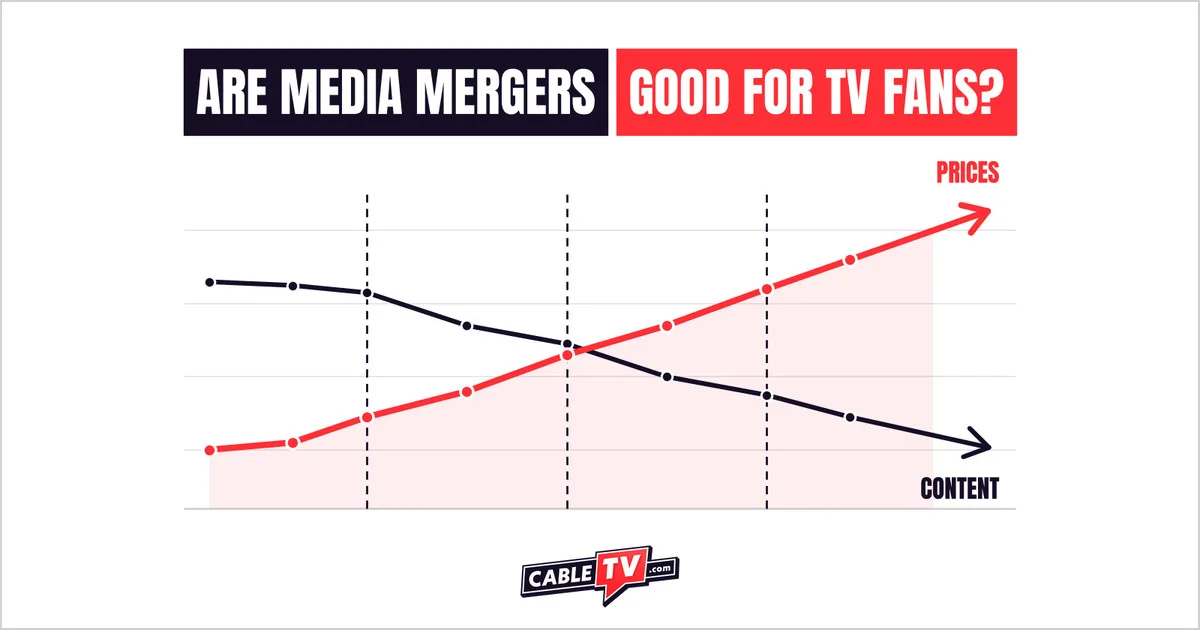
What does “cutting the cord” even mean these days?
Not so long ago, streaming was supposed to liberate TV fans from the shackles of cable TV and telecom monopolies. Streaming cost way less and offered more flexibility, straight up.
But then came one mega media acquisition after another. Sure, the modern media merger timeline stretches back to the Obama administration and transcends party lines, but since the pandemic, we’ve seen an acceleration.
Echoing a popular online opinion, one Reddit user recently groused, “They’re just reinventing cable.” Indeed, once heroically romanticized, streaming has entered its villain era.
Comment
byu/MarvelsGrantMan136 from discussion
in
When it comes to media mergers and streaming, the editors at CableTV.com wanted to dig deeper than CEO promises of “improved customer experience” and online forums littered with valid but untested opinions.
In this report, I’ll look at historical data and statistical correlations to get to the bottom of whether these streaming mergers benefit you, TV fans.
Keep up with all the latest in entertainment news
Subscribe to CableTV.com's email newsletter for the latest TV event viewing guides, entertaining takes, and money-saving promotions.
By signing up, you agree to our Privacy Policy & Terms and Conditions.
Do streaming service mergers result in price hikes?
Since the salad days of cable, fans have complained about TV price increases, and the streaming era is no different, especially when it comes to mergers.
To that point, one Reddit user recently carped, “Disney+Hulu {sic} combined didn’t get cheaper — the no-ads tier went up. WBD merging with Paramount means one fewer competitor in the market, which historically means less pressure to keep prices down.” Perhaps it goes without saying that it’s relatively easy to come across similar (if not slightly more angry) statements in the wild.
That’s all well and good: A lot of online sentiment indicates that TV fans are disillusioned, but are prices really going up? My colleague Olivia Bono has been tracking streaming service price increases for over five years now, and TL;DR: Yes, streaming prices have risen dramatically over the past five years and beyond.
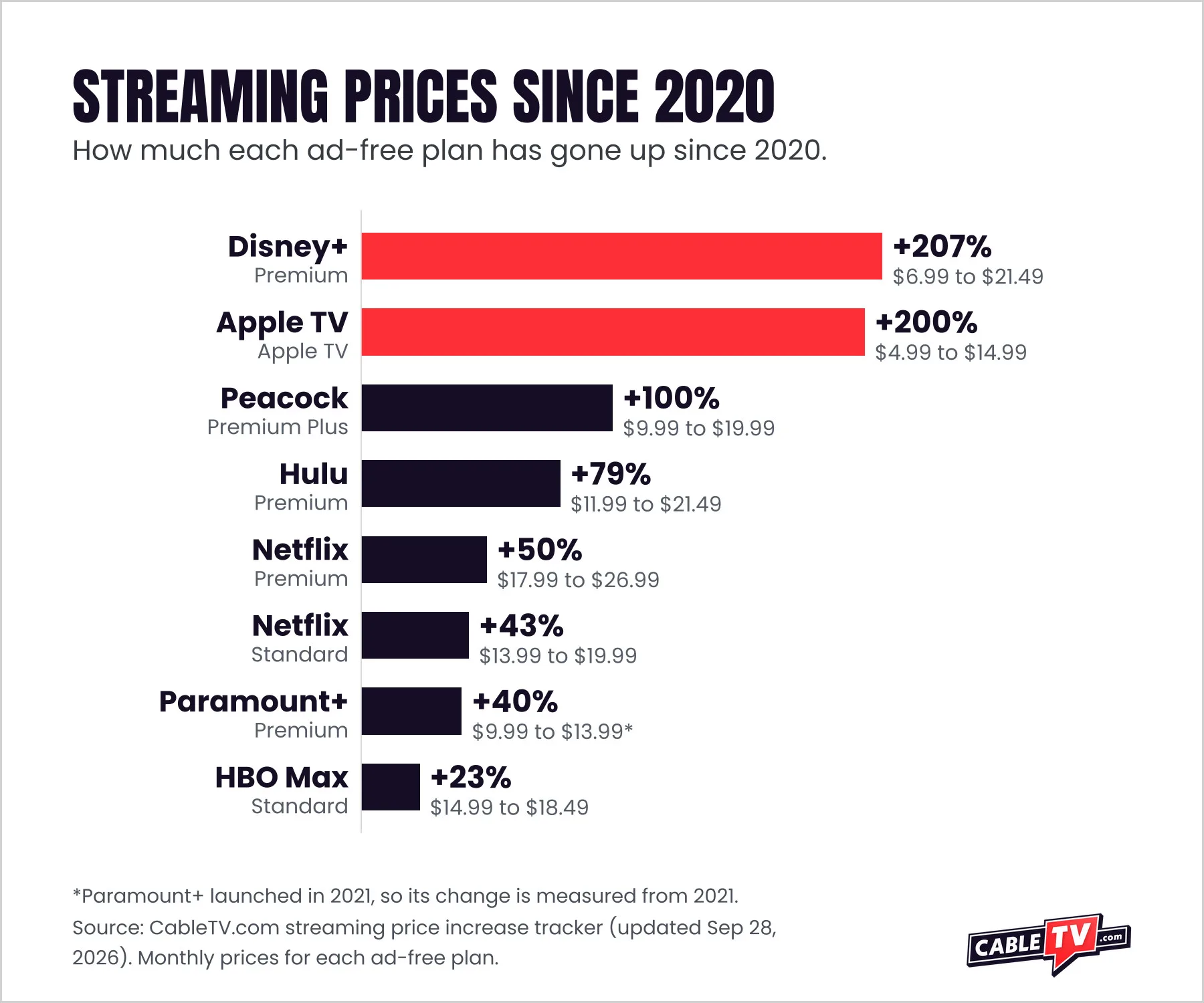
Ms. Bono’s broader research found that, in aggregate, streaming prices are up nearly 85% since 2020, with ad-free Disney+ and Apple TV plans up more than 200%. To put those percentages in context, streaming price increases overwhelmingly outpaced cumulative inflation of about 30% over the same period.
Price trends: Merged vs. non-merged streaming services
So, streaming prices are up across the board, but do they correlate with mergers?
To test whether media consolidation drives higher subscription costs, we compared price increases at merged platforms with those at non-merged competitors.
We define a “merged” streaming service as one whose parent company has acquired, been acquired by, or merged with another media or streaming company.
Both groups raised prices sharply, but the data doesn’t show merged services rising faster.
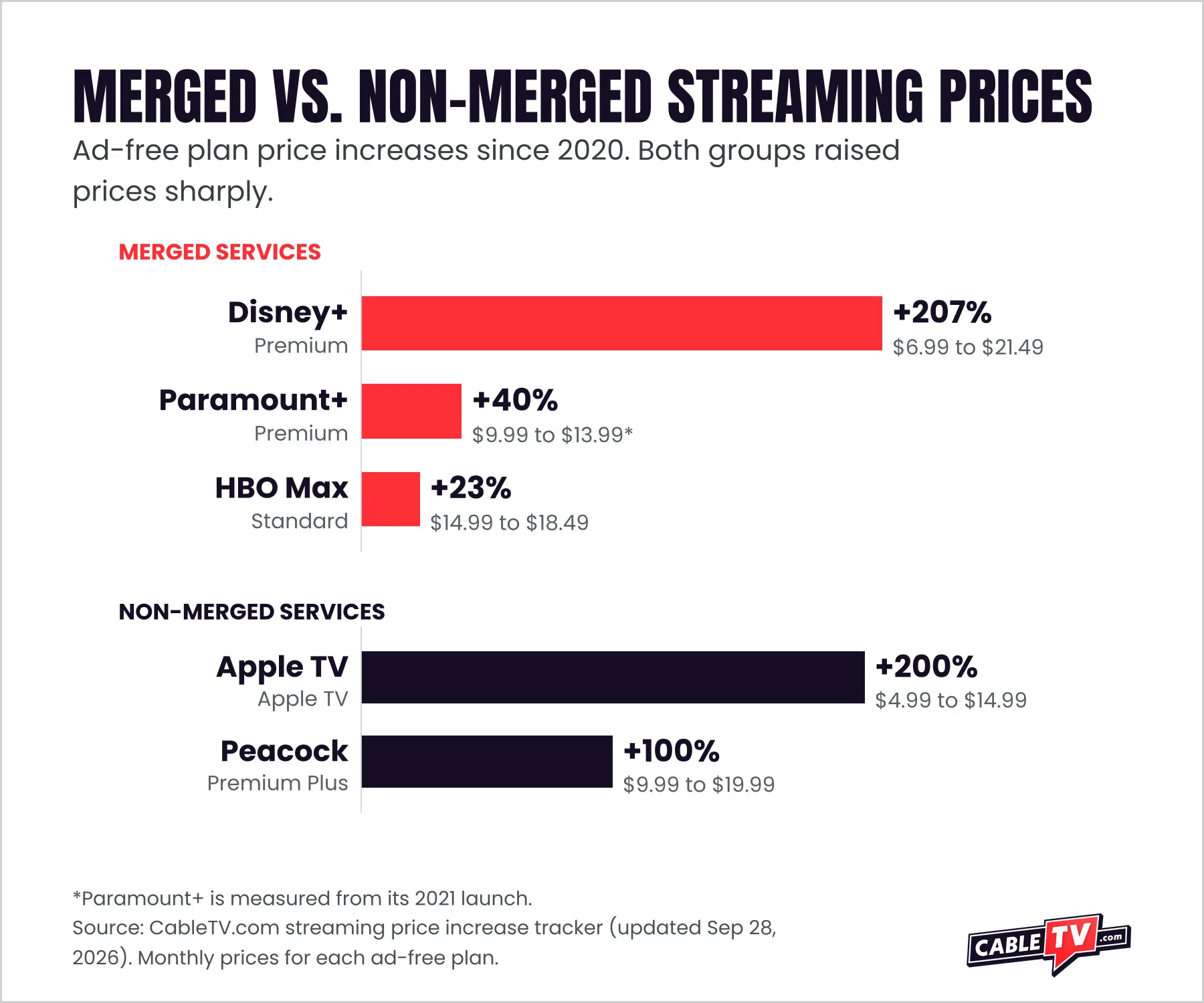
Comparing ad-free tiers, Disney+ rose 207%, Paramount+ rose 40%, and HBO Max rose only 23%, while Apple TV rose 200% and Peacock rose 100%. Only Disney+ (+207%) outpaced the non-merged services. Not only that, but because tracking dates differ by service, this suggests a market-wide trend rather than a merger effect.
Bottom line: Media mergers and acquisitions aren’t predictive of future streaming price increases; post-merger price increases correlate with broader industry trends.
With little to no government regulation or oversight aside from the proposed, sports-focused For the Fans bill, will cash-strapped TV fans see any relief on the horizon? Something’s gotta give, right?
As Michael Goodman, Director of Entertainment Research at Parks Associates, put it in a 2025 Parrot Analytics report, “Until we see net adds stall or decline as a result of price hikes, services have no incentive to stop raising prices,” with “net adds” meaning subscribers gained minus subscribers lost.
Will your favorite shows go away after a streaming merger?
Regardless of mergers, streaming price increases will likely continue unless TV fans stop subscribing en masse. But do media mergers and streaming app consolidations translate into more content for fans, as many media CEOs claim?
Our research found that fluctuations in TV library size show a mixed pattern. As we reported what seems like an eternity ago, Disney+ removed 73 shows from its library in 2023, four years after Disney acquired a majority stake in Hulu, as it began consolidating the two apps.
Likewise, HBO Max pulled 36 titles in August 2022, ahead of combining content libraries with Discovery+. NPR described them as mostly less-watched shows, such as “Genera+ion” and “Summer Camp Island,” and said the cuts would likely save on residuals.
What the data shows about TV library sizes
Looking at broader trends, however, these high-profile content library cuts are the exception, even if the headlines have stuck with frustrated TV fans.
Mostly, TV shows coming and going from your streaming service of choice align with monthly licensing changes rather than merger-related cost-saving strategies.

Customers are used to titles switching services, but it feels like a betrayal when original content goes away forever. I've had to buy several shows ("Grease: Rise of the Pink Ladies," "She-Ra and the Princesses of Power") on DVD because I don't know if they'll ever be on streaming again.
I know I just said Disney+ cut dozens of TV shows from its content library amid app consolidation in 2023, but it also grew its TV library 38% in 2025, according to Reelgood data.
What goes up must come down. Our analysis of historical JustWatch library data also showed no correlation between shrinkage in TV show libraries and merger-related app consolidation.
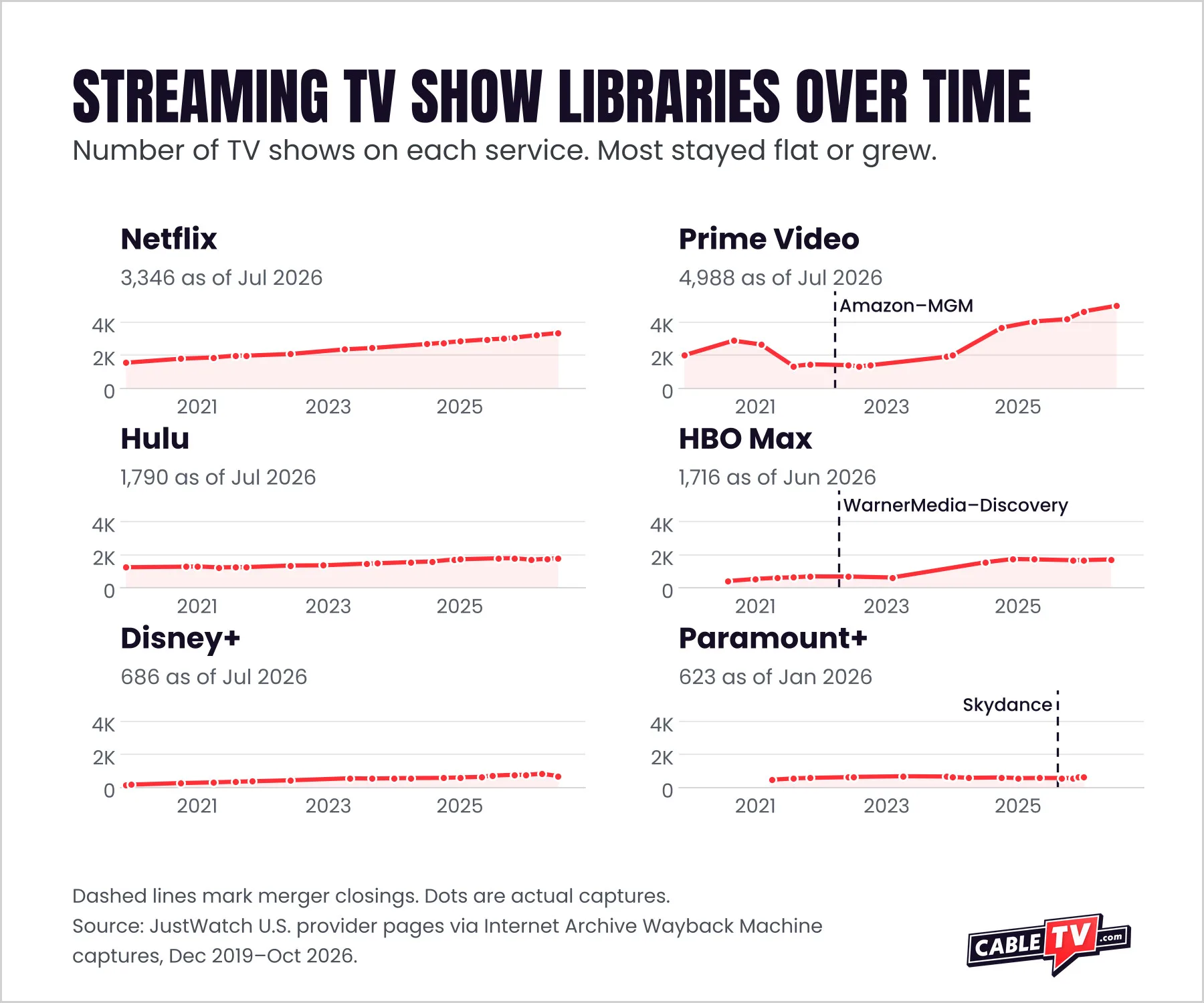
Bottom line: Overall, our research shows that TV show library sizes have remained flat or grown over time across streaming services, indicating that mergers and consolidations haven’t significantly affected the quantity of TV shows.
But what about your favorite movies?
If you’re like me, movie catalogs are a big reason why you subscribe to certain streaming services. For example, I watch my TCM favs on HBO Max and my Universal monster movies on Peacock.
But like TV shows, movie titles often move (no pun intended) between streaming services because of licensing agreements, which makes it even harder to get to the bottom of content cuts driven by mergers and other non-licensing factors.
Ironically, I logged into Peacock earlier this month to stream James Whale’s “Frankenstein” (1931) with my family, but the Universal monster movie is now on an app I’ve never heard of (Classix+?!?), even though it was on Peacock the month prior. Curse you, licensing!
That said, our data still indicates a correlation between mergers, app consolidation, and cuts to movie libraries.
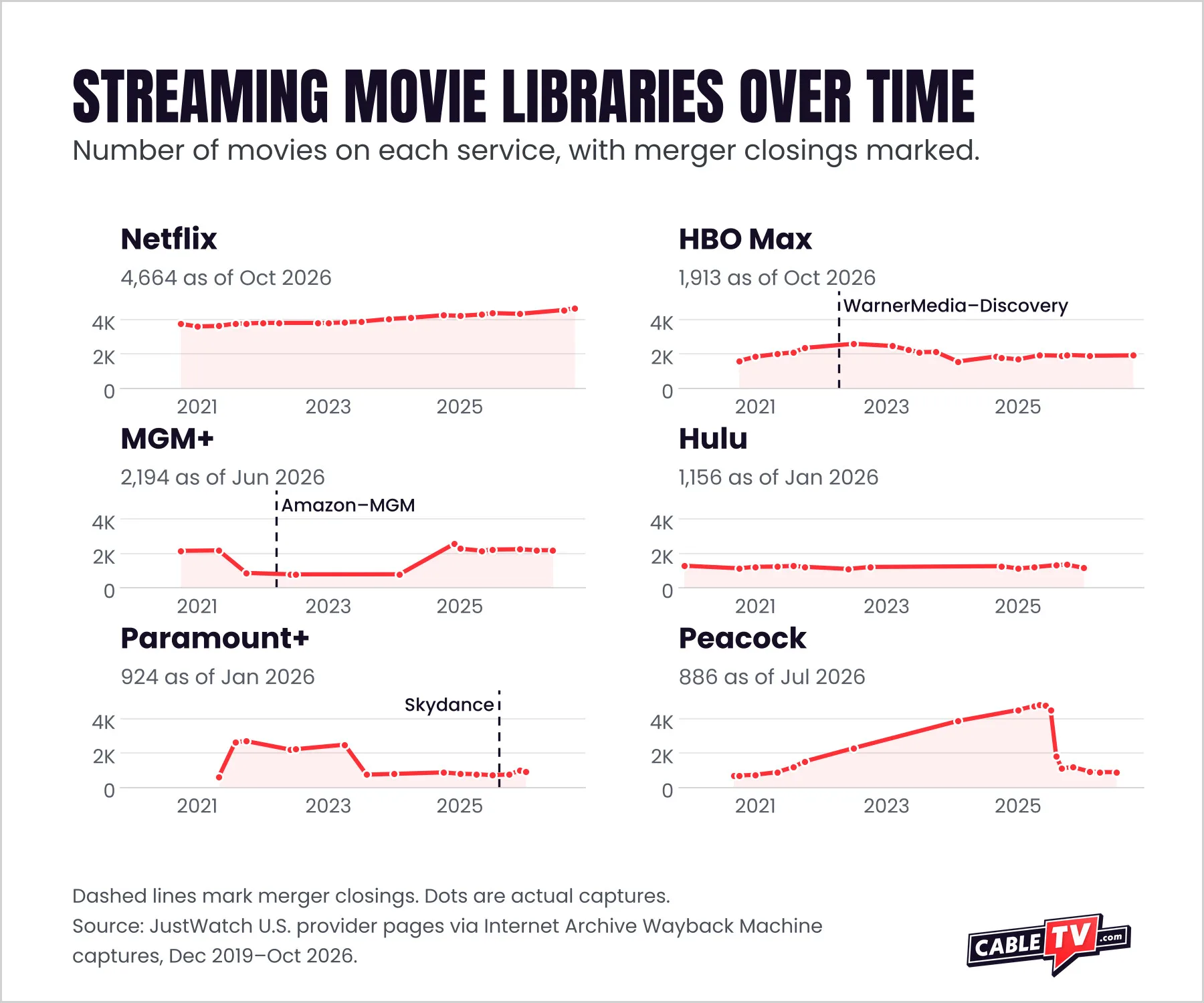
Putting movie library declines in context
But first, a couple of outliers: Peacock and Prime Video. Because of our data collection methods, the Peacock dataset is hard to explain: We couldn’t find many archived Peacock Reelgood tracking pages from late 2021 to late 2024. In summer 2025, however, the Peacock movie library numbers fell off a cliff, from about 4,700 titles to roughly 1,100.
Reelgood confirmed the precipitous drop with Peacock, and industry insiders speculated in the LinkedIn thread that it was due to, you guessed it, licensing agreements and reduced supply from the WGA and SAG-AFTRA strikes. Either way, the cuts involved a non-merged streaming service.
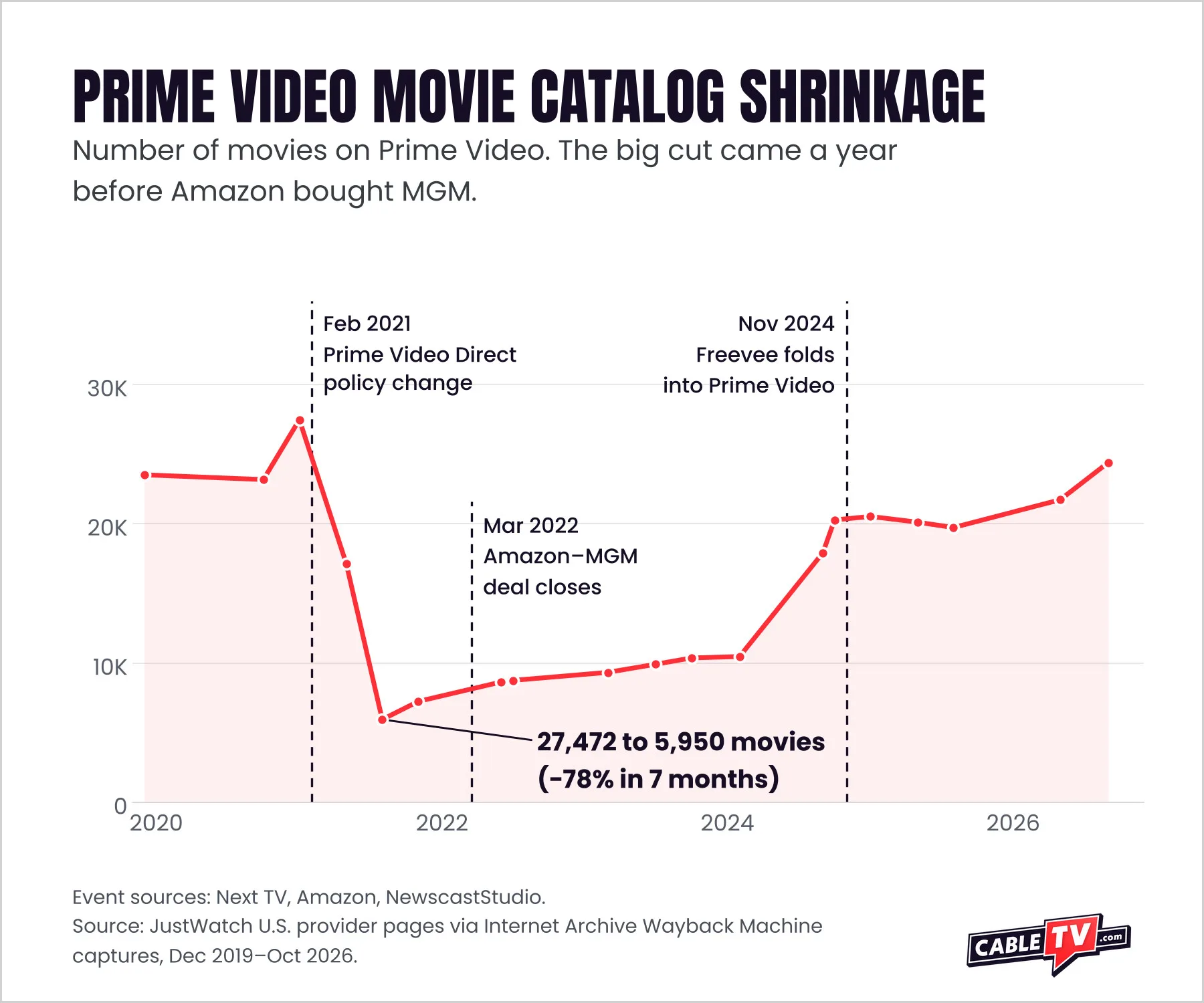
With Prime Video, you’ll notice a massive drop about a year before the MGM merger closed that directly correlates with policy changes to its Prime Video Direct program, as it worked to become a more curated video streaming marketplace.
IMO, the curatorial aspect of significantly reducing self-funded and user-generated content dovetails sufficiently with acquiring the storied MGM movie catalog to suggest a merger-motivated culling of content.
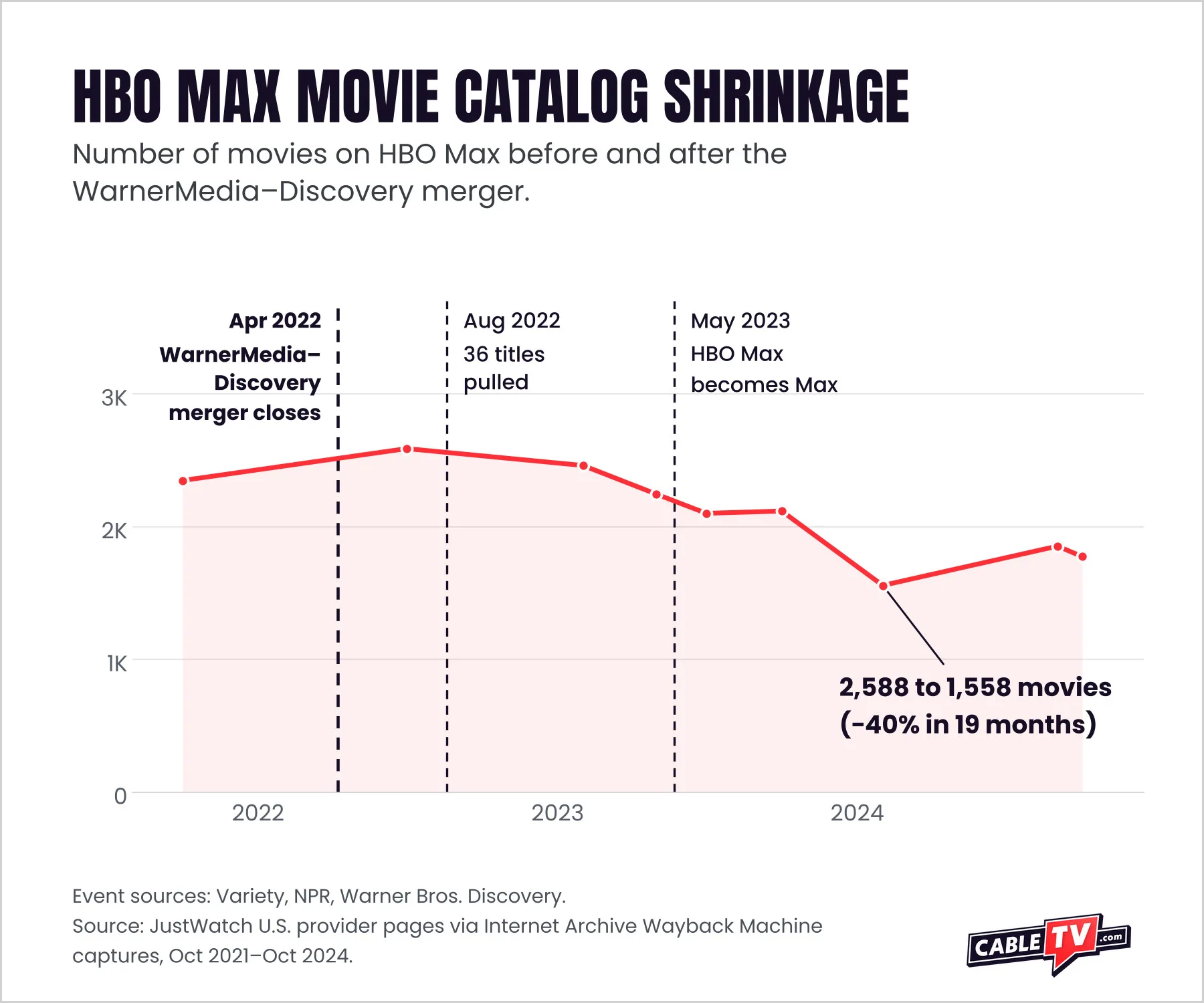
Other, less apocalyptic correlations exist between movie library cuts and mergers. For example, HBO Max’s movie catalog fell about 40% in the 19 months after the WarnerMedia–Discovery deal, while its show count more than doubled.
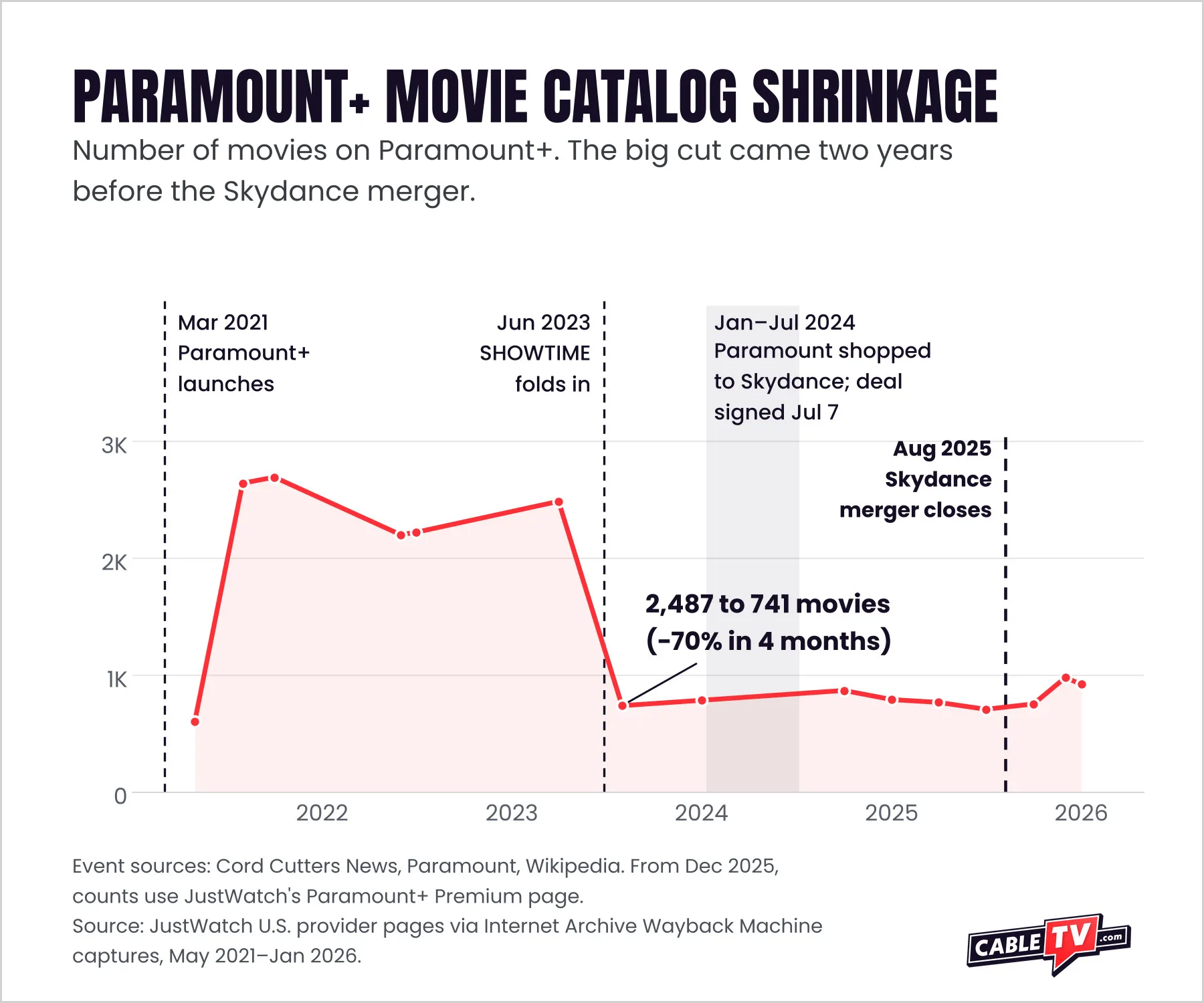
Likewise, Paramount+ slashed its movie catalog as it rolled SHOWTIME into the Paramount+ app, just before its former parent company, National Amusements, started shopping it to future parent company Skydance.
Even though the pattern appears fairly straightforward across merged services, I wanted to look more closely at a recent media acquisition and app consolidation: Paramount Skydance’s 2026 buyout of Tyler Perry’s shares in BET+ and the app’s subsequent closure.
Case study: BET+ Originals
Streaming services usually don’t publish which titles get axed during mergers and app consolidation, so we used crowdsourced data and ran our own numbers.
We searched Paramount+ for every title on Wikipedia’s BET+ Originals list (168 titles), and a mere 62 titles turned up. In a nutshell, most of the original series made it over, but the lion’s share of the movies didn’t make the cut.
I reached out to parent company Skydance to confirm my findings, but it “respectfully declined to comment” through a spokesperson.
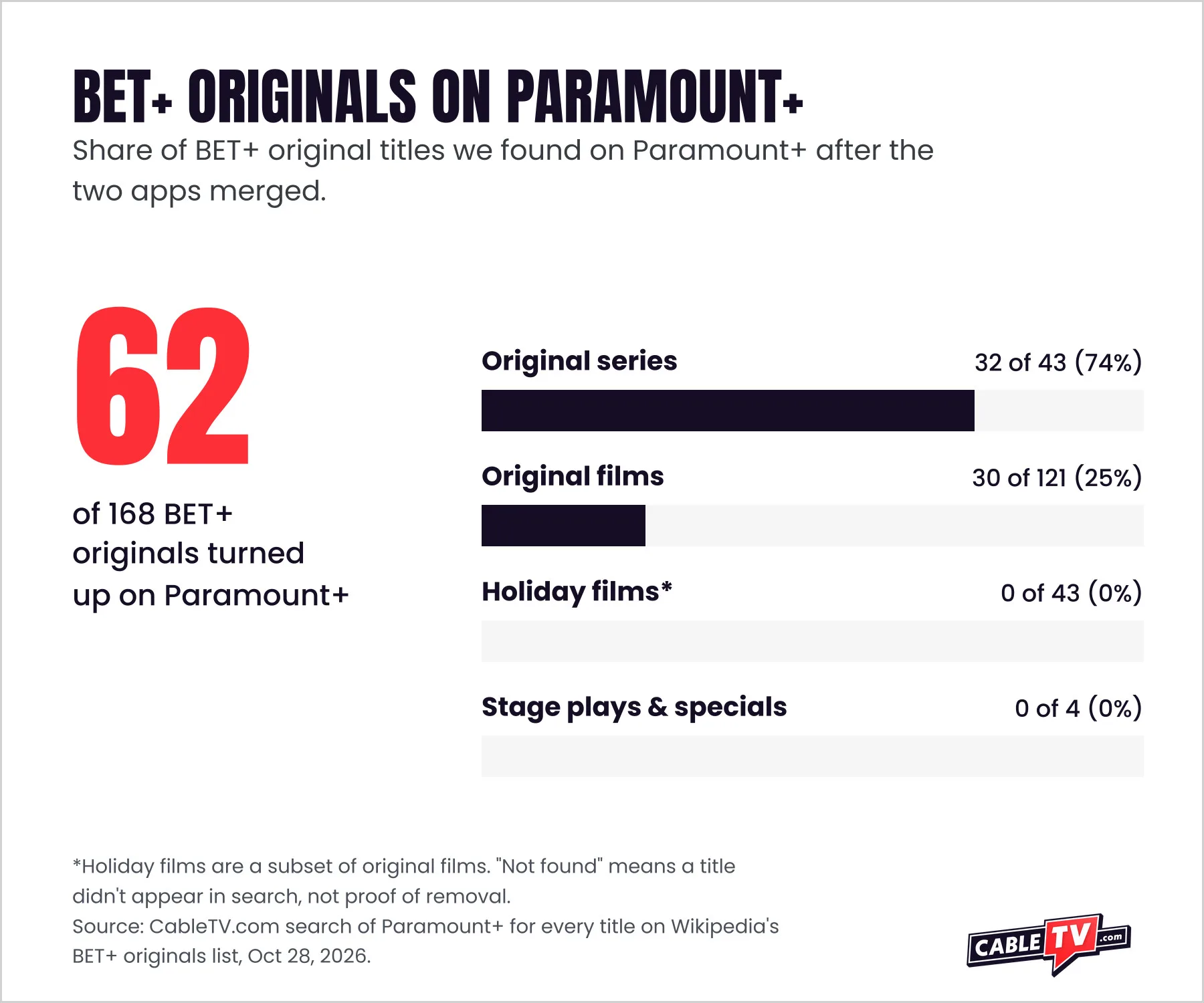
More specifically, in October 2026, none of the 43 BET+ Original holiday movies came up in our search. That includes “The Business of Christmas,” “A Wesley Christmas” and its sequels, “Never Alone for Christmas,” and “Brewster’s Millions: Christmas.”
After I ran the numbers, Cord Cutters News reported that Pluto TV (the other streaming app affected by the Paramount Skydance–Warner Bros. merger) will include a BET Holiday Movies channel, and Paramount+ just announced that 14 BET holiday movies are coming back for the season, but that’s still 36 movies that haven’t shown up yet.
Now, it’s reasonable to assume that the movies that went missing immediately after the app consolidation might show up later on Pluto TV, Paramount+, or the future combined Skydance app.
Also, movies labeled “BET+ Original” or “BET Original” are most often produced by third-party studios, like MarVista Entertainment (owned by Fox) and MegaMind Media (independent), so licensing renewals are still at play.
Which brings me to my next point (and case study): whether app consolidation encourages what I call “quiet culling,” or the non-renewal of licensing agreements during moments of accelerated app consolidation.
Case study: Hulu, independent film licensing, and quiet culling
According to our research, Hulu’s massive 2025 movie losses came from third-party movie licenses expiring, while Disney kept its owned Fox, Searchlight, and FX libraries.
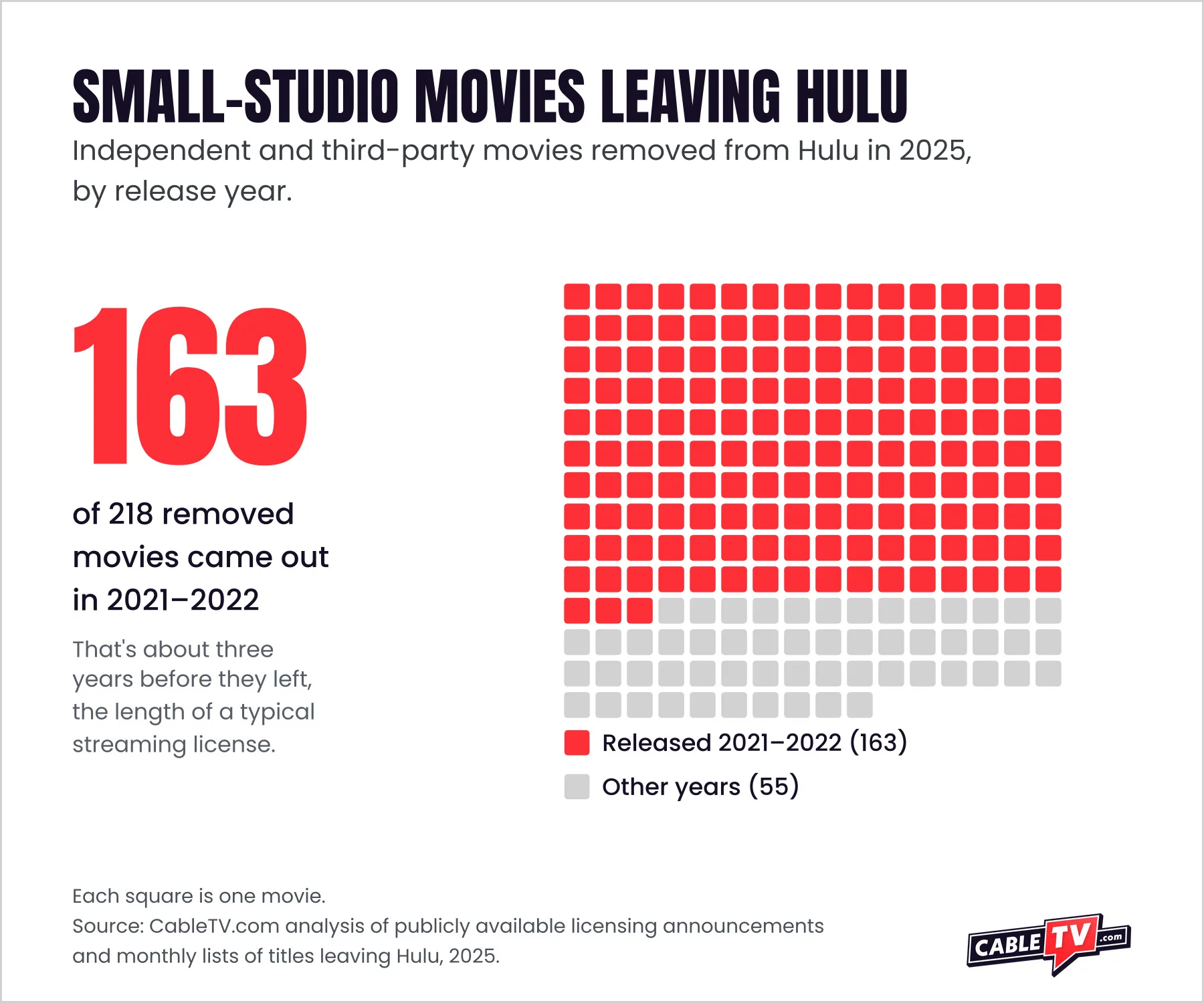
After digging up publicly available licensing announcements and triangulating that data with monthly lists of titles leaving Hulu, we found that 163 of the 218 removed small-studio movie titles came out in 2021–2022.
The films left Hulu about three years after release, matching the length of a typical streaming license and lining up with the acceleration of the Hulu–Disney+ app consolidation.
The timeline also makes sense when you consider Hulu’s history as a clearinghouse for multiple media companies like Disney, Comcast, and Fox.
UCLA professor Yihao Yuan, an expert in exclusive licensing, remarked in a wide-ranging interview with CableTV.com: “My concern with Hulu has always been that there are so many different titles there, and it’s so difficult to find what you’re really interested in. It has a little bit of everything.”
Hulu doesn’t have a film studio, but Disney does, and it fully acquired Hulu from Comcast’s NBCUniversal in 2025, so replacing third-party produced movies and the Universal catalog with Disney properties could help with Hulu’s identity crisis and save on licensing fees.
My concern with Hulu has always been that there are so many different titles there, and it's so difficult to find what you're really interested in.
It’s very plausible that Disney chose not to renew those third-party licenses because of consolidation. Having learned my lesson about streaming services and media companies refusing to comment on library shrinkage, I reached out to several studios affected by the expired licensing, like IFC and Neon, to see whether quiet culling was a factor.
To date, no smaller, independent studio has responded to my requests. Still, the timing is hard to ignore, and it’s an easy way for a streaming service to avoid negative headlines like the ones circulating circa 2022–2023 while maintaining plausible deniability.
Bottom line: Our research shows a strong correlation between movie library shrinkage and streaming app consolidation, with media companies attributing the quiet culling of titles to licensing renewal.
Coda: The future of streaming mergers and app consolidation
Over the past two years, FCC Chairman Brendan Carr has overseen a series of mergers involving streamers and media companies like Paramount, Skydance, and Warner Bros. Discovery. His tenure has also included major telecommunications deals, such as Verizon’s purchase of Frontier Communications and Astound Broadband’s buyout of Google Fiber. But Carr’s rubber-stamping days may be over soon.
As Politico recently reported, congressional leaders now “intend to pursue all avenues of investigation, including into how Carr’s agenda has affected people’s pocketbooks and TV content.” Time will tell, but as we pointed out earlier, historically, media and streaming mergers have been party agnostic, with the Obama, Trump, and Biden administrations all green-lighting their fair share of mega purchases.
What comes next for TV fans
In the meantime, a tectonic streaming merger was just finalized on November 6, 2026: Fox–Roku. I say tectonic because Fox Corp.’s purchase includes not just The Roku Channel, with all its original and licensed content, but also Roku devices and other streaming services like Frndly TV and Howdy.
This is one of the few times we’ve seen a major media company buy a large tech firm, meaning Fox now owns the whole content pipeline from creation to distribution to algorithmic recommendations to OS ad sales, just like tech giants Apple and Amazon.
From my point of view, Fox honoring its published commitments “to continuing to operate Roku as an open, partner-friendly platform” is more interesting than any speculated, far-off Netflix–NBCUniversal deal because it could mean Fox prioritizing its media holdings at the expense of Roku users.
Professor Yuan put it this way in our interview: “If you have an algorithm, you can potentially steer consumers across different platforms.” If you’re anything like me, you probably don’t love being steered too much in any direction by a media company.
Bottom line: As this report indicates, TV fans can expect continued price increases, steady production of platform-exclusive content, and smaller movie vaults due to quiet culling. Sure, it ain’t cable, but it ain’t great either.
Featured in this report
We really like the value of Disney+ bundles, but we’ll have to wait and see what the new combined Hulu–Disney+ app looks like comparatively.

I love HBO Max’s exclusive content and deep movie catalog. Skydance would be foolish to lose the HBO name (cough, cough, Max) when they roll out the combined app.

HBO fans aren’t very enthused about adding Paramount+ to any future bundles or a combined app, but I think the SHOWTIME content alone will make it worth it.
Methodology
Our editorial team used CableTV.com’s historical streaming price data to compare subscription price changes with media merger timelines. We also examined changes to TV and movie libraries using archived Reelgood and JustWatch pages accessed through the Internet Archive. Our research included title-level reviews of BET+ Originals and Hulu departures, an interview with a licensing researcher, and requests for comment from relevant companies.
Who we are
At CableTV.com, we’re not just entertainment experts — we’re fans like you. While our first priority is reporting the best, most accurate information about TV providers and streaming services, we also love talking about our favorite shows, movies, and sporting events. You can count on us to share our honest opinions and unbridled enthusiasm. For more on our process, check out our Editorial Policy.
More entertaining coverage from CableTV.com

I’ve compiled data on all of our favorite streaming services to see the bigger picture. Which services are making reasonable changes, and which are taking advantage of economic panic?


With all of the streaming services out there, why are people still paying for cable TV? Live sports and comfort are the big reasons.

U.S. sports fans spend an average of $65.92 a month on live TV services, yet blackouts, buffering, and broadcast delays still disrupt viewing.
