

How much is Netflix now?
Netflix’s last price increase was in March 2026. In an earlier version of this page, I incorrectly predicted that Netflix would wait until 2027 for its next price increase. Unfortunately, it seems like Netflix is joining its competitors in increasing prices once a year.
Netflix has always been a pretty expensive luxury, and yet it’s got the highest subscriber count of any streaming service. It’s been a must-have for years now. So exactly how much has Netflix changed its prices since its inception? Does it deserve our loyalty and our cash? In short, is it still worth it?
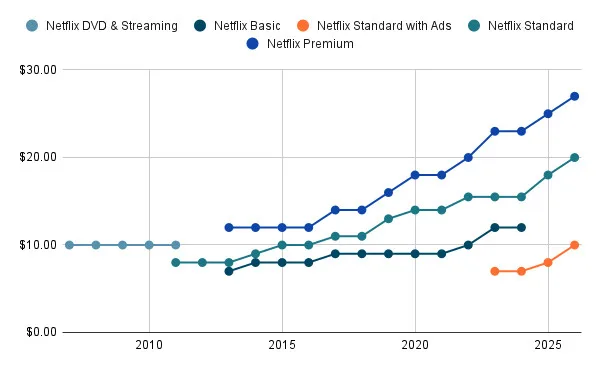
Netflix monthly price history since 2007
| Netflix DVD & Streaming | Netflix Basic | Netflix (Basic/Standard) with Ads | Netflix Standard | Netflix Premium | |
|---|---|---|---|---|---|
| 2007 | $9.99/mo. | — | — | — | — |
| 2008 | $9.99/mo. | — | — | — | — |
| 2009 | $9.99/mo. | — | — | — | — |
| 2010 | $9.99/mo. | — | — | — | — |
| 2011 | $9.99/mo. | — | — | $7.99/mo. | — |
| 2012 | — | — | — | $7.99/mo. | — |
| 2013 | — | $6.99/mo. | — | $7.99/mo. | $11.99/mo. |
| 2014 | — | $7.99/mo. | — | $8.99/mo. | $11.99/mo. |
| 2015 | — | $7.99/mo. | — | $9.99/mo. | $11.99/mo. |
| 2016 | — | $7.99/mo. | — | $9.99/mo. | $11.99/mo. |
| 2017 | — | $8.99/mo. | — | $10.99/mo. | $13.99/mo. |
| 2018 | — | $8.99/mo. | — | $10.99/mo. | $13.99/mo. |
| 2019 | — | $8.99/mo. | — | $12.99/mo. | $15.99/mo. |
| 2020 | — | $8.99/mo. | — | $13.99/mo. | $17.99/mo. |
| 2021 | — | $8.99/mo. | — | $13.99/mo. | $17.99/mo. |
| 2022 | — | $9.99/mo. | — | $15.49/mo. | $19.99/mo. |
| 2023 | — | $11.99/mo. | $6.99/mo. | $15.49/mo. | $22.99/mo. |
| 2024 | — | $11.99/mo. | $6.99/mo. | $15.49/mo. | $22.99/mo. |
| 2025 | — | — | $7.99/mo. | $17.99/mo. | $24.99/mo. |
| 2026 | — | — | $8.99/mo. | $19.99/mo. | $26.99/mo. |
Netflix’s history is a long and confusing one. If you can remember all the way back to 2007, Netflix’s streaming service began as a fun perk for its DVD subscribers. Streaming was a complete novelty—no longer would you have to wait for a disc to arrive in the mail, or worry about sending it back! This combined service was $9.99/mo. (With inflation, that would be about $16.05 today.)
But things changed in 2011 when Netflix introduced what would later be known as Netflix Standard—a standalone, ad-free HD streaming service that only cost $7.99/mo. Over time, Netflix added two additional tiers: Netflix Basic, which cost less but only provided one SD stream, and Netflix Premium, which was more expensive but provided four simultaneous streams and 4K content.
Netflix kept these three tiers for a long time, raising their prices every couple of years, until 2022, when they introduced Basic with Ads. This cost $6.99/mo., and offered HD content with an “average of 4 to 5 minutes of ads per hour.” At the same time, they upgraded the Basic plan to also offer HD content (a move that was probably long overdue).
Netflix, like other streaming services, found a lot of success with its ad-supported plan. It’s an ingenious business model: They get money from both subscribers and advertisers. You know, like old-school cable channels did.
Eventually, the Basic with Ads plan did so well that Netflix decided it should be its only “budget” option. That means they discontinued the still ad-free Netflix Basic in 2024, and existing subscribers were automatically switched to Basic with Ads. Well, sort of. Netflix actually rebranded the plan as “Standard with Ads,” rebranding it as the main alternative to the Standard plan.
… And things have just sort of gotten more expensive from there. Its March 2026 price increase has cemented Netflix as the most expensive streaming service around. While other services have more expensive ad-supported plans, Netflix’s ad-free and 4K tiers outpace its competitors’ prices.
Honestly, it’s wild to me that there’s a whole $10/mo. difference between the ad-supported and ad-free plans. It definitely feels like Netflix would rather fans sign up for the cheap plan so that they can claim double income from advertisers, rather than trying to make the more expensive plans appealing.
Netflix price satisfaction over time
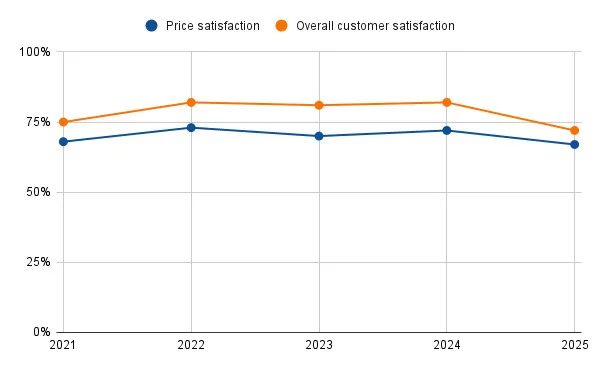
Unfortunately, we don’t have customer satisfaction data for the nearly two decades that Netflix has been in the streaming game. We’ll have to stick to the 2021–2025* range for our analysis.
Netflix’s customer satisfaction graph looks a little different from Peacock’s. While Peacock’s price satisfaction sticks very closely to its overall customer satisfaction, Netflix customers give the service a little bit of wiggle room. Overall satisfaction is generally higher than price satisfaction—customers aren’t happy with rising prices, but they’re willing to forgive the service for it.
If I had to guess, it’s because of the Netflix brand’s image as the “default” streaming service. More people subscribe to Netflix than any other service, so if rising prices cause customers to start cancelling, they’ll get rid of other names before Netflix.
*For context, we usually publish our survey results in January of a given year, so our information is taken from the summer of the previous year. I’m using the year the survey was actually taken in this graph and chart, rather than the year the survey was published.
Netflix price increases vs. inflation
Netflix has existed for a long time, so it makes sense that its prices have risen over time. But have they risen to a reasonable degree? I did some research with the help of my friend, the U.S. Bureau of Labor Statistics’ CPI Inflation Calculator.
Netflix introduced its streaming service in January 2007 and tends to increase prices in January, so I’ll be using January as my representative month for each year.
How has inflation influenced Netflix’s price since 2007?
When Netflix introduced DVD & Streaming in 2007, the plan was $9.99/mo., which would be $16.05/mo. in 2026. It’s hard to directly compare that to its 2026 price of $19.99/mo., especially considering how much Netflix’s library has grown. And that original price did include a mail-in DVD service, which of course no longer exists.
So let’s look at 2011, when Netflix introduced its standalone service for $7.99/mo. Accounting for inflation, that would cost $11.80/mo. in 2026. Its actual price became $19.99/mo. That means that when adjusted for inflation, Netflix is still charging $8.19/mo. more than it did at launch. And while I say Netflix’s library has grown, it’s also shrunk considerably. It infamously loses the rights to popular content all the time, including so-called Netflix Originals.
One of my favorite Netflix Originals, “She-Ra and the Princesses of Power,” was released in 2018 in collaboration with DreamWorks Animation. In 2018, a Netflix Standard subscription cost $10.99/mo. With inflation, that would be $14.42/mo. in 2026. The actual price of $19.99/mo. is still $5.50/mo. more than it should be.
When I originally wrote this article with 2025 data, that number was only $3.91/mo. That’s how fast Netflix is outpacing inflation.
Netflix removed “She-Ra” from its platform in February 2026 (and will remove 100+ more Originals over the course of the year) with no word of where the title is going to land next. Is Netflix really worth $5.50/mo. more if its library is shrinking?
Why you can trust us
At CableTV.com, we’re all about the small details, especially when it comes to plans and prices. You can count on our writers and editors to put accuracy above all else, putting in the hours to find the most accurate plans for the most popular services. For more information on our research process, head over to How We Rank.
